
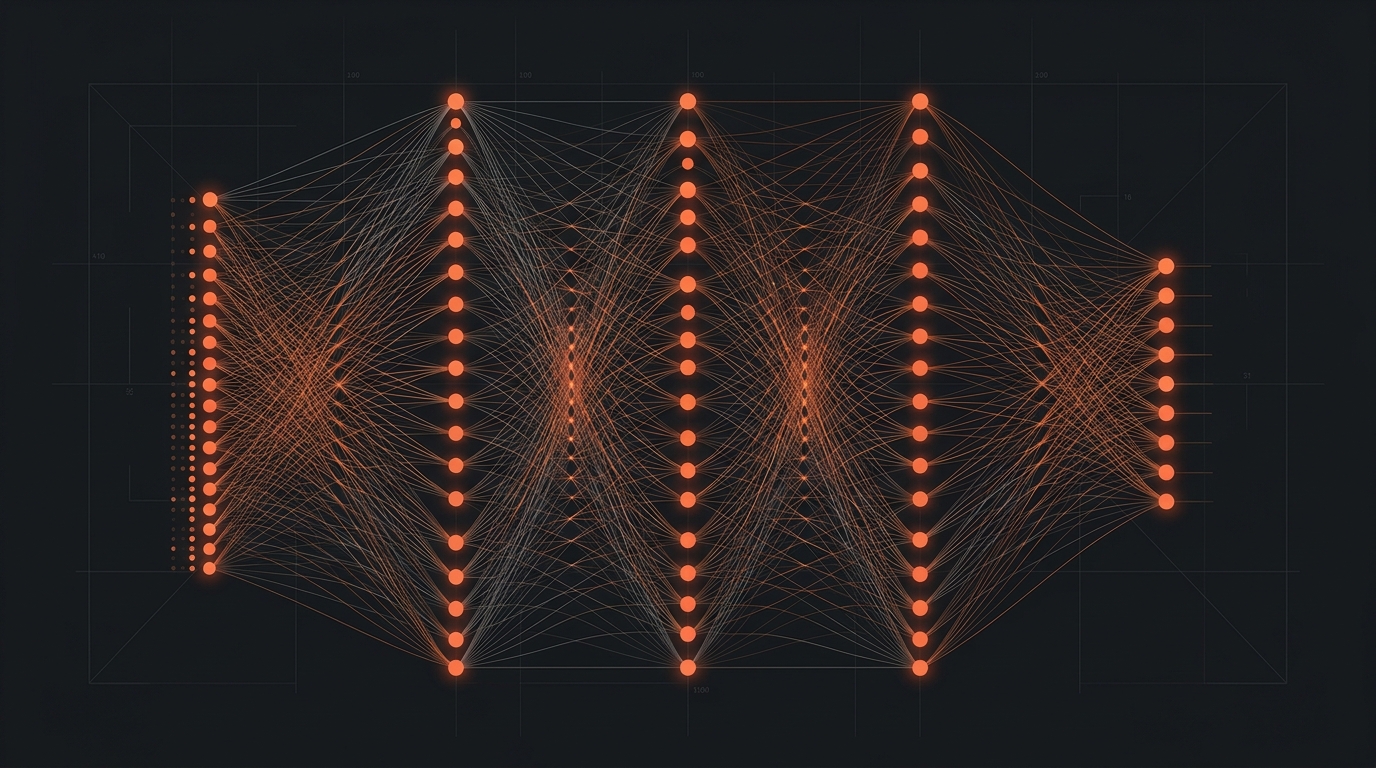
The pursuit of Artificial General Intelligence (AGI) is currently constrained by a fundamental architectural bottleneck: the reliance on massive, centralized data centers. While the current paradigm of scaling transformer models on clusters of H100s has yielded impressive results in pattern matching and token prediction, it lacks the biological hallmarks of general intelligence: persistent state, local adaptability, and environmental grounding. True autonomy requires a shift toward decentralized, continuously evolving edge architectures.
Centralized models are inherently static snapshots of past data. They operate on a ‘frozen’ intelligence cycle where training and inference are decoupled. To move toward AGI, we must transition to systems that treat the edge not as a peripheral delivery mechanism, but as the primary site of computation and continuous learning.
The Limitations of Centralized Inference
Centralization introduces latency, privacy risks, and single points of failure that are antithetical to the robust, real-time decision-making required for AGI. When an AI agent must query a centralized API to understand its immediate physical environment, it is effectively handicapped by network jitter and the cloud provider’s rate limits. Furthermore, the cost of scaling centralized compute linearly with the number of agents is economically unsustainable.
In a centralized architecture, the model is a black box owned by a third party. This creates an alignment paradox where the agent’s ‘values’ are determined by the provider’s safety filters rather than the agent’s interaction with its local context. A sovereign AGI requires the ability to retain local state and adapt its weights based on immediate, high-fidelity sensory input without round-tripping to a central server.
The Edge as a Learning Substrate
Moving intelligence to the edge implies more than just model quantization or local inference. It requires a fundamental rethinking of how models are updated. We need architectures that support federated, continuous learning where the model evolves as it interacts with the world, rather than relying on periodic batch updates from a central repository.
interface EdgeNode {
  id: string;
  localWeights: Float32Array;
  updateState(observation: SensoryInput): void;
  syncGradients(peerNodes: EdgeNode[]): Promise<void>;
}

class AutonomousAgent implements EdgeNode {
  // Represents a local, evolving model instance
  async process(input: SensoryInput) {
    const prediction = await this.infer(input);
    const reward = this.evaluate(prediction);
    if (reward < threshold) {
      await this.backpropagateLocally(input, reward);
    }
  }
}
Distributed Consensus for Model Integrity
If we decentralize the model, we face the challenge of weight divergence. How do we ensure that agents operating at the edge maintain a coherent understanding of the world? The solution lies in peer-to-peer consensus mechanisms that allow agents to exchange gradients without central coordination. By treating model weights as a distributed ledger, we can ensure that local improvements are propagated globally without sacrificing the autonomy of the individual node.
Trade-offs and Engineering Challenges
- Weight Divergence: Managing how local updates impact global model stability.
- Resource Constraints: Balancing inference accuracy with the thermal and power envelopes of edge hardware.
- Security: Mitigating adversarial attacks on decentralized model nodes.
- Data Sovereignty: Managing the tension between local privacy and the need for shared learning.
These challenges are significant, but they are engineering problems rather than theoretical dead-ends. The shift from monolithic models to modular, distributed intelligence is the necessary evolution for systems that need to function in complex, unpredictable environments.
Conclusion
The future of AGI is not a bigger model sitting in a data center; it is a swarm of intelligent, autonomous agents learning in real-time at the edge. By decentralizing the architecture, we gain resilience, privacy, and the ability to adapt to environments that are too dynamic for static models. The sovereign path to AGI requires that we stop building ‘services’ and start building ‘organisms’ that live and evolve within the infrastructure itself.