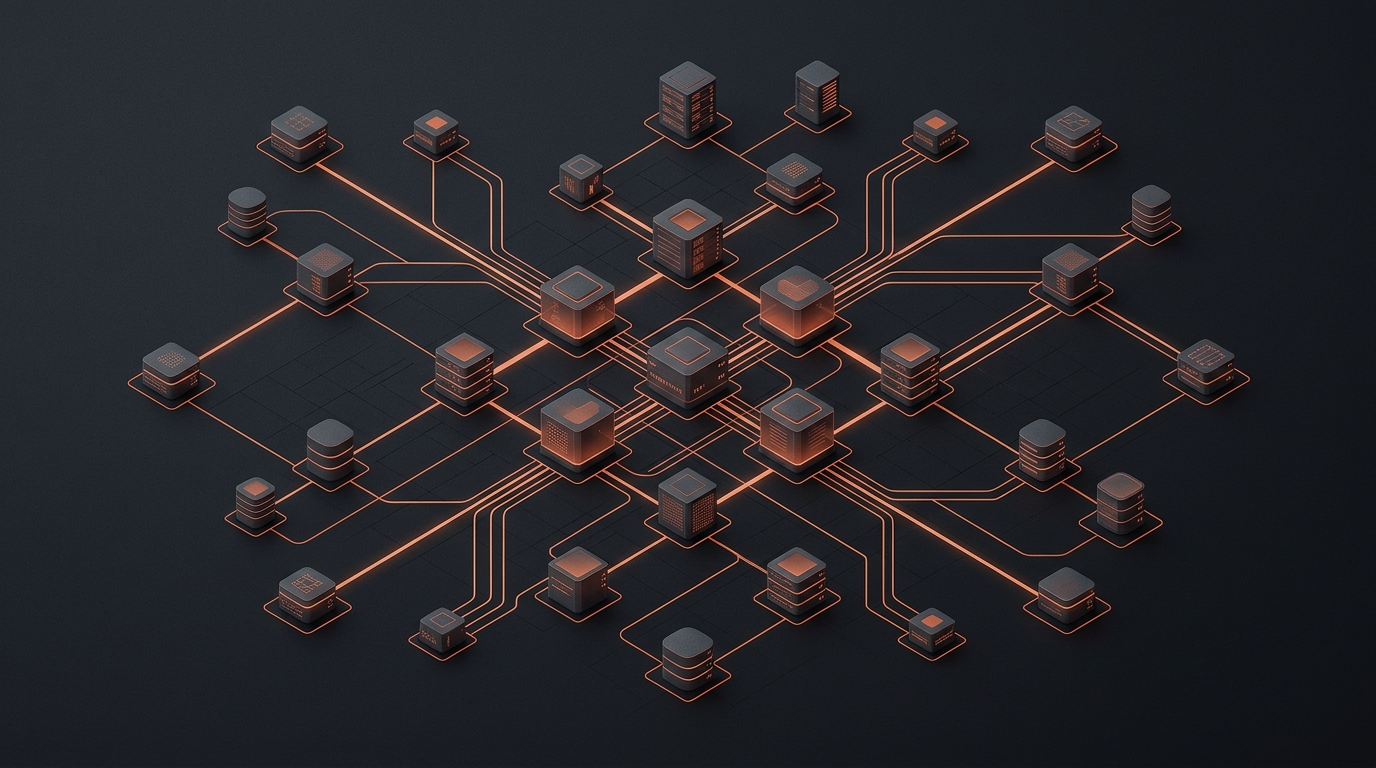
The 'Optimus Prime' Architecture: Orchestrating Unified Command in Agent Fleets
An analysis of the Optimus Prime pattern for multi-agent orchestration, focusing on hierarchical command structures and state synchronization in distributed AI systems.
Technical analysis and dispatches tagged with "distributed-systems".
An analysis of the Optimus Prime pattern for multi-agent orchestration, focusing on hierarchical command structures and state synchronization in distributed AI systems.
Analyzing the architectural requirements for synchronizing large-scale physical assets with digital twins through robust data engineering pipelines.
Technical architecture is often viewed through the lens of code and infrastructure, but the most resilient systems are built upon the foundation of team trust.
An analysis of the architectural trade-offs, signaling challenges, and cryptographic complexities involved in building a decentralized P2P messenger.
An analysis of the architectural requirements for high-concurrency QR code redirection systems, focusing on latency, state management, and infrastructure stability.
An analysis of how Nubank leveraged Clojure and a distributed microservices architecture to build a resilient, scalable core banking system.
An analysis of a production failure where an autonomous agent's non-deterministic behavior masked a subtle database transaction leak.
An analysis of evolving cloud architecture patterns, focusing on serverless orchestration, edge computing, and infrastructure-as-code strategies for 2026.
An analysis of the Canvas architecture, a paradigm for multi-agent financial modeling that replaces traditional sandboxed code execution with declarative state transitions.
An analysis of cache stampede mechanics and four robust architectural patterns to prevent catastrophic database load during key invalidation events.
An analysis of the modular monolith as an architectural pattern that enforces strict boundary discipline while avoiding the distributed system overhead of microservices.
A deep dive into building asynchronous, cost-optimized LLM pipelines using message queues to bypass rate limits and maximize free-tier throughput.
Moving beyond architectural dogma to evaluate the operational and cognitive costs of system decomposition through a structured decision framework.
An analytical examination of horizontal and vertical data scaling strategies, focusing on the trade-offs between partitioning, sharding, and the operational complexity of distributed storage.
An analytical comparison of message brokers for modern microservices architectures, evaluating performance, throughput, and operational trade-offs.
An analytical deep-dive into the architectural decisions behind TigerBeetle, focusing on how its LSM-tree design, memory-mapped I/O, and consensus protocols achieve financial-grade throughput.
An analysis of foundational architectural archetypes, examining how system topology dictates operational constraints and why patterns are rarely interchangeable.
An analysis of why monolithic ERP dashboards fail to provide actionable supply chain visibility in the pharmaceutical industry and how to transition to event-driven architectures.
An analysis of architectural trade-offs in e-commerce, focusing on inventory consistency, service decomposition, and database selection for high-traffic systems.
An exploration of building decoupled, event-driven architectures using Python, focusing on message brokers, schema management, and fault tolerance.
An analysis of how infrastructure failures inform the design of fault-tolerant AI training and inference pipelines in large-scale environments.
An architectural deep-dive into cross-repository dependency management and graph-based linking within the Enola ecosystem.
An analysis of the architectural failure mode in AWS Bedrock integration that leads to exponential cost inflation during model inference.
An analysis of the architectural challenges in building real-time ride-matching systems, focusing on geospatial indexing, low-latency dispatching, and distributed state management.
An analysis of why monolithic single-process architecture in Rust provides superior performance, safety, and operational simplicity for resource-constrained edge AI deployments.
Moving beyond static redundancy to embrace adaptive, fault-tolerant system design that survives the unknown.
A deep-dive into the mechanics of the TCP three-way handshake, state transitions, and the lifecycle of reliable transport connections.
An analysis of the architectural requirements for deploying robust, low-latency AI models at the industrial edge, focusing on fault tolerance and data synchronization.
An analysis of the architectural trade-offs when integrating high-throughput vector search into microservices-based enterprise ecosystems.
An analytical examination of building distributed systems with Python, focusing on service boundaries, communication patterns, and operational trade-offs.
An analytical look at the architectural complexities behind GitHub's historical service disruptions and the lessons for resilient system design.
An analysis of the skip list data structure, exploring its probabilistic balancing mechanics and why it serves as the foundation for Redis sorted sets.
An analysis of Bloom filters, their mathematical foundations, and the trade-offs involved in using probabilistic structures for high-performance membership testing.
An architectural examination of decoupling write and read models through event sourcing and CQRS to improve system scalability and auditability.
An analysis of why centralized cloud-based LLMs are insufficient for AGI and how decentralized edge computing provides the necessary substrate for autonomous intelligence.
An exploration of the iterative and recursive processes involved in DNS resolution, covering caching layers, protocol mechanics, and the path from local stub resolver to authoritative nameserver.